Own
70% to 100%Your brand reaches the first three named positions in at least seven of every ten successful observations.
Next move: Defend the query with current product evidence and source coverage.
Buyer-intent measurement
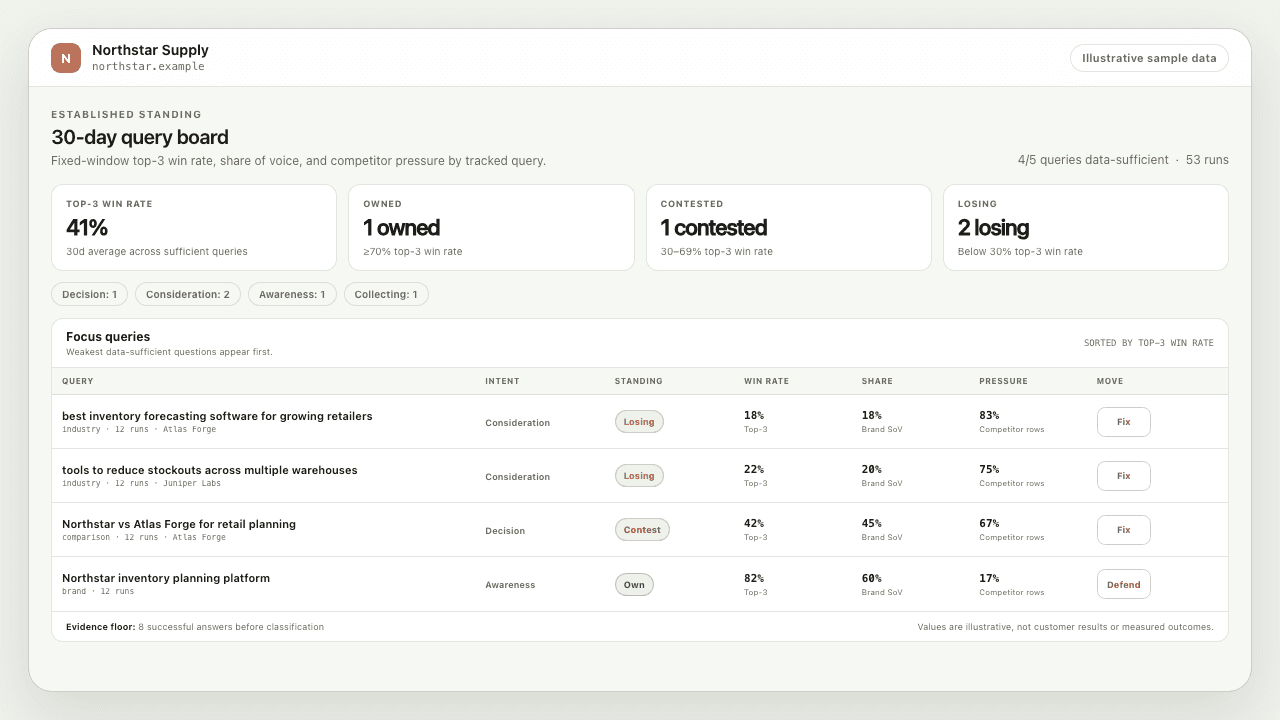
See exactly which questions put your brand on the shortlist and which need work. Foglift Buyer-intent Win Rate measures how often you reach the first three named positions for every tracked query, then classifies each data-sufficient question as Own, Contest, or Lose. The fixed 30-day board keeps every question on the same evidence window.
Published formulas
Use top-three win rate to classify the query, then use rank-one rate, mention rate, share of voice, and competitor pressure to understand the result. Every denominator contains successful answers only.
| Measure | Numerator | Denominator | Use |
|---|---|---|---|
| Top-three win rate | Successful answers where the brand appears in positions 1 to 3 | All successful answers for that query in the window | Primary input for Own, Contest, and Lose |
| Rank-one rate | Successful answers where the brand appears in position 1 | All successful answers for that query in the window | Shows how often the brand leads the recommendation set |
| Brand mention rate | Successful answers that mention the brand | All successful answers for that query in the window | Separates inclusion from recommendation position |
| Brand share of voice | Tracked-brand mentions | Tracked-brand mentions plus tracked-competitor mention slots | Measures the brand's share of observed appearances |
| Competitor pressure | Successful answers naming at least one tracked competitor | All successful answers for that query in the window | Shows how often alternatives enter the answer |
Top-three win rate = answers with brand at positions 1 to 3 / all successful answers for the query × 100
Position requires a brand mention and a returned numeric rank from 1 through 3. A mention without a qualifying position still stays in the denominator and can contribute to mention rate.
Query standings
The thresholds turn a repeated answer pattern into a clear operating state. Collecting remains a fourth, explicit state so a small sample never looks like a measured loss.
Your brand reaches the first three named positions in at least seven of every ten successful observations.
Next move: Defend the query with current product evidence and source coverage.
Your brand earns prominent placement, but the outcome remains inconsistent across repeated observations.
Next move: Compare the winning sources and strengthen the highest-attainability gap.
Your brand reaches the first three named positions in fewer than three of every ten successful observations.
Next move: Attack the exact query with the evidence-backed action tied to it.
The evidence floor has not been met, so the product withholds a standing.
Next move: Keep the prompt active until the remaining run count reaches zero.
Buyer-intent map
Foglift classifies every active prompt into decision, consideration, or awareness. Explicit comparison and pricing language takes precedence over broader category language.
See how prompts are discovered and watched| Intent | Prompt signals | Question |
|---|---|---|
| Decision | Comparison, versus, pricing, price, review, alternative | Which option should the buyer choose? |
| Consideration | Best, top, tool, software, platform, category or use-case language | Which products belong on the shortlist? |
| Awareness | Remaining active prompts without decision or consideration signals | Does the brand enter the buyer's problem space? |
Evidence contract
The query board and the adaptive buyer-intent lens share the same successful-answer boundary. The fixed board supports query standing; the separate lens can use the first data-sufficient window among 14, 30, 60, and 90 days for longer-term top-three and rank-one trend review.
The read path filters provider-error rows before the query model runs. The core calculation applies the same defensive boundary, so a failed engine call cannot lower a rate, satisfy the evidence floor, or create competitor pressure.
Every query standing uses the 30 days ending at calculation time. The board does not stretch a weak query across older history to manufacture enough evidence.
A query needs 8 successful observations before any percentage or standing is treated as data-sufficient. The product shows the remaining run count while evidence is still collecting.
Configured competitor aliases and discovered mentions are canonicalized to the tracked set before pressure and share-of-voice calculations. Duplicate names inside one answer do not create duplicate row-level pressure.
Current plan boundary
Growth and Enterprise monitor ChatGPT, Claude, Perplexity, Gemini, and Google AI Overview. Faster allowed cadence creates more observations; teams can still select a slower supported schedule.
| Plan | Price | Included evidence | Fastest cadence |
|---|---|---|---|
| Growth | $129/mo | Ten brands, all five engines, Buyer-intent Win Rate, and sitemap scanning | Up to twice daily |
| Enterprise | Custom | Custom workspace allowances, all five engines, and Buyer-intent Win Rate | Up to hourly |
Source and method boundaries
Win Rate measures whether and where a brand appears in the returned answer. Provider citations remain separate evidence, and the buyer-intent research explains why one prompt cannot represent a category.
Documents web-search answers and source metadata. Win Rate uses the returned answer position as its measured unit and keeps citations separate.
Documents cited web-search responses from supported Claude requests and the source blocks available with the answer.
Explains that AI features may use different models, techniques, and supporting link sets. Each engine therefore remains a distinct observation source.
Foglift Research measured how discovery, shortlist, and variation prompts retrieve different source sets across the same categories.
FAQ
Buyer-intent Win Rate measures how often a brand appears in the first three named positions for a tracked query. Foglift calculates it query by query from successful AI-answer observations, then keeps rank-one rate, mention rate, brand share of voice, and competitor pressure as separate measures.
Foglift divides successful answers where the tracked brand appears in positions one through three by all successful answers for the same query and window, then multiplies by 100. Provider-error rows never enter the numerator or denominator.
A query needs at least eight successful answer observations inside the fixed 30-day Query Board window. Until then, Foglift labels the query Collecting and shows how many additional runs are needed instead of assigning an Own, Contest, or Lose standing.
Own means the brand's top-three win rate is at least 70%. Contest covers rates from 30% through 69%. Lose means the rate is below 30%. The labels summarize measured prominence for one query; they do not prove why an engine selected a brand.
Foglift groups active prompts into decision, consideration, and awareness buckets. Comparison, pricing, review, and alternatives language maps to decision. Best, top, tool, software, platform, and use-case language maps to consideration. Remaining active prompts map to awareness.
Competitor pressure is the percentage of successful answers for a query that name at least one tracked competitor. Brand share of voice divides the tracked brand's mentions by that brand's mentions plus tracked-competitor mention slots. The first measures how often alternatives appear; the second measures the brand's share of observed appearances.
Buyer-intent Win Rate starts on Growth at $129 per month. Growth includes ten brands, all five tracked engines, and monitoring up to twice daily. Enterprise uses custom pricing and supports monitoring up to hourly. Teams can select a slower allowed cadence.
Turn standing into action
Growth starts at $129 per month with all five engines, up to twice-daily monitoring, and query-level Win Rate. Each measured query links into the action workflow with its standing and competitor evidence intact.