AI search prompt intelligence
Stop monitoring questions nobody asks
Foglift finds buyer questions with demand behind them, shows the related searches returned by AI engines, and keeps the cited pages and brand context beside every decision. Move the right prompt into monitoring without rebuilding the evidence trail in another tool.
- Discovery output
- Up to 25 ranked candidates per run
- Fanout sources
- Claude, Perplexity, and Google AI Overview
- Paid boundary
- Four advanced surfaces from $49/mo
One evidence chain
Turn one buyer question into a complete evidence trail
Keep the demand, returned searches, citation pages, brand guidance, and next decision together. Every layer stays labeled, so your team knows which signal came from the market and which came from an answer.
01 / Discover
Rank questions with demand attached
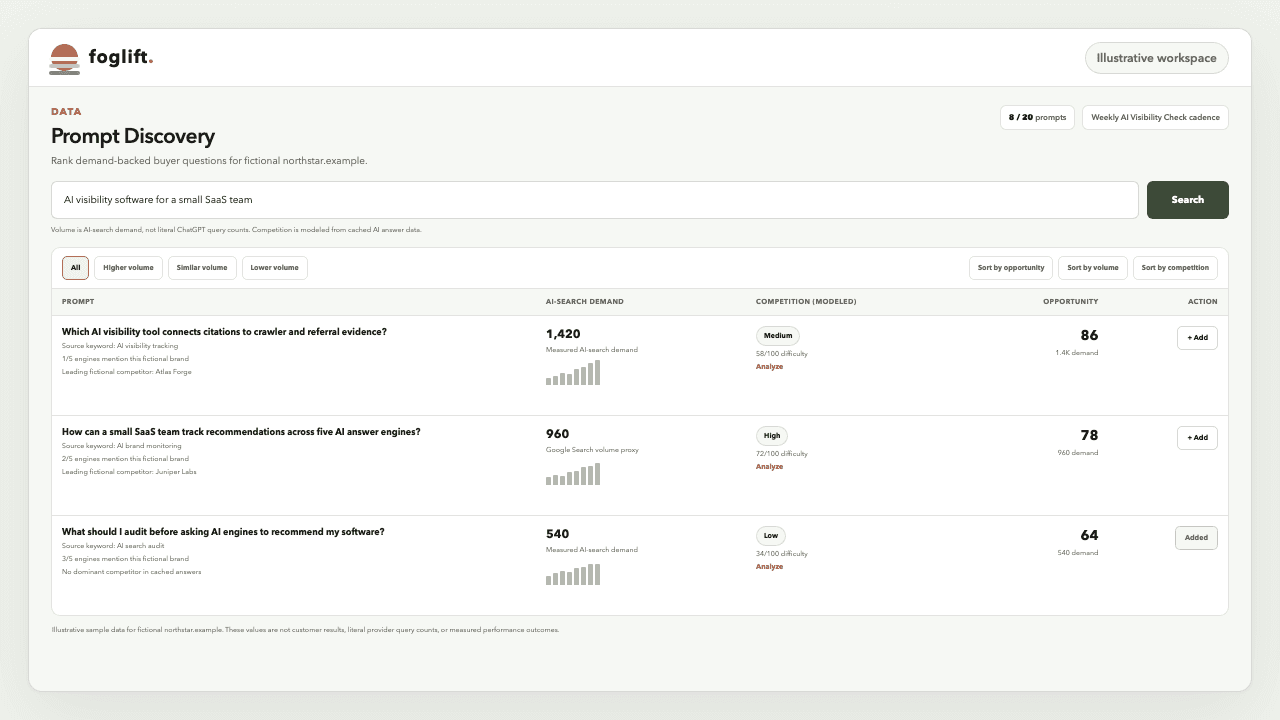
Start from a question, product, keyword, industry, competitor, or site context. Prompt Discovery generates up to 25 candidates and labels the demand source, trend, modeled difficulty, visibility gap, leading competitor, cited source, and opportunity score.
The list uses external demand inputs plus cached workspace answers. It does not spend a new monitoring run on every candidate.
02 / Observe
See the related searches an engine returned
Query Fanouts preserve the sub-queries returned by Claude, Perplexity, and Google AI Overview. Repeated wording is clustered under the tracked prompt with occurrence count, contributing engines, and first-seen and last-seen dates.
A missing engine means the current provider response does not expose a compatible fanout field. It does not mean that engine used only the visible prompt.
03 / Protect
Pin the page whose citation matters
Watched Pages match normalized citation URLs, count current and previous 30-day appearances, split results by engine, and keep a daily trend. A watched non-root path also includes matching URLs beneath that path.
Only citations returned with monitored answers enter the count. Missing provider citations stay unavailable.
04 / Ground
Give generated work reusable brand context
Knowledge Bases store Brand Kit, Audience, and Reference entries. Content briefs and automation recipe reports can apply this bounded context, while prohibited phrases are kept separate from positive guidance.
The product records whether context was applied. A knowledge entry does not rewrite historical monitoring evidence.
05 / Decide
Ask a question against workspace evidence
Ask Foglift routes simple questions to a fast answer and deeper questions to bounded workspace reads. It can explain visibility, citations, competitors, trends, audits, and next actions, then present an enabled action for approval.
An action proposal is not silent automation. The user sees the action, scope, and estimated token cost when applicable before approval.
Prompt Discovery contract
Put real demand behind every prompt
Spend monitoring capacity on questions buyers are already signaling. Discovery accepts up to 12 unique seed terms, requests demand-backed ideas, shapes them into buyer questions, and persists the top 25 candidates.
- Demand
- AI search volume when measured; otherwise a labeled Google Search volume proxy
- Gap
- Current brand absence and competitor concentration in cached answer evidence
- Source pressure
- Cited-source evidence already attached to related monitored answers
- Opportunity
- A comparable score for sorting candidates, never a traffic or citation guarantee
Query Fanout contract
See the searches hiding behind an AI answer
Discover the more specific questions an engine used around your prompt. Foglift records compatible fields returned with the monitored response and groups equivalent wording for review.
| Engine | Returned field | Evidence stored |
|---|---|---|
| Claude | Web-search tool query | The search query used by a returned tool-use block |
| Perplexity | Related questions | The related-question strings returned with a monitored answer |
| Google AI Overview | Grounding search queries | The web-search queries in returned grounding metadata |
ChatGPT and Gemini do not appear in this table because their current monitoring responses do not expose a compatible fanout field. Their prompt results still remain part of AI Visibility on supported plans.
Plans and limits
Unlock the workflow at the scale you need
Start finding and promoting prompt opportunities after sign-in. Launch adds four paid intelligence surfaces, five-engine monitoring, developer access, and the first capacity allowances.
| Plan | Monthly | Discovery and observation | Knowledge and Ask |
|---|---|---|---|
| Free | $0 | Prompt Discovery after sign-in; promotion respects the workspace prompt allowance | No Query Fanouts, Watched Pages, Knowledge Bases, or Ask Foglift |
| Launch | $49/mo | Five-engine monitoring up to daily, Query Fanouts, and three Watched Pages | One Brand Kit; 20 Ask messages and one full review per day |
| Growth | $129/mo | Five-engine monitoring up to twice daily and ten Watched Pages | Three Brand Kits, five Audience entries, five References; 100 Ask messages and three full reviews per day |
| Enterprise | Custom | Five-engine monitoring up to hourly and unlimited Watched Pages | Unlimited Knowledge Base entries, Ask messages, and full reviews |
Primary definitions
Keep demand and retrieval evidence straight
Search volume describes historical demand. A returned fanout describes one observed retrieval path. A watched citation describes a page attached to one answer. These sources answer different questions and stay labeled separately in Foglift.
- Google Ads API: Historical keyword metrics
Defines average monthly Google Search volume, monthly history, and competition fields used as demand evidence.
- Google Search Central: Query fan-out
Defines fan-out as concurrent related queries used to retrieve additional relevant results and warns against one page per variation.
- OpenAI Help Center: Search query rewriting
Explains that ChatGPT search may rewrite a prompt into one or more targeted provider queries and may run more specific follow-ups.
Primary sources reviewed September 8, 2026.
Questions
Choose the right prompt workflow
What is prompt intelligence for AI search?
Prompt intelligence connects the buyer questions worth monitoring to the related searches an answer engine may run, the pages those answers cite, and the workspace evidence needed to choose the next action. Foglift keeps those layers separate so a modeled opportunity is never presented as an observed citation.
How does Foglift rank Prompt Discovery opportunities?
Foglift starts with demand-backed keyword ideas, creates question-shaped candidates, and ranks up to 25 opportunities. The displayed opportunity considers measured or proxy demand, the brand's current mention gap, competitor concentration, and cited-source pressure from cached answer data. Generating the list does not run a new AI Visibility Check for every row.
Which engines expose Query Fanouts in Foglift?
Foglift currently captures returned related queries from Claude, Perplexity, and Google AI Overview. It groups repeated wording into clusters and preserves the contributing engines plus first-seen and last-seen dates. ChatGPT and Gemini stay absent from this view because their current monitoring responses do not expose a compatible fanout field.
What does a Watched Page measure?
A Watched Page counts provider-returned citation URLs that match the normalized page. Foglift compares the current 30-day count with the previous 30 days, separates counts by engine, and plots a daily trend. The result is citation evidence, not proof that a page caused an answer or that an engine indexed every page it considered.
What can I store in Knowledge Bases?
Knowledge Bases accept Brand Kit, Audience, and Reference entries. Brand guidance can shape content briefs and automation recipe reports while banned-language rules are removed from positive output guidance and enforced separately. Launch includes one Brand Kit; Growth includes three Brand Kits, five Audience entries, and five References; Enterprise allowances are unlimited.
What can I ask Ask Foglift?
Ask Foglift answers questions about workspace visibility, competitors, citations, trends, Technical Audits, and next actions. It can use bounded workspace evidence for deeper questions and can propose actions, but a user must approve an enabled action before Foglift executes it. Launch includes 20 messages and one full review per day; Growth includes 100 messages and three full reviews per day; Enterprise allowances are unlimited.
Which prompt-intelligence features are available on each plan?
Prompt Discovery is available after sign-in and promotion respects the workspace's prompt allowance. Query Fanouts, Watched Pages, Knowledge Bases, and Ask Foglift begin on Launch at $49 per month. Growth costs $129 per month and raises watch, knowledge, and Ask limits. Enterprise uses custom pricing with unlimited allowances for those three capacity-limited surfaces.
Does a fanout query mean I should create a separate page?
No. A fanout is evidence of a related retrieval question, not an instruction to publish another URL. Review the existing page, the buyer intent, the cited sources, and the recommendation before choosing to strengthen a page or create a new one. Google also warns against producing separate pages for every fanout variation simply to manipulate AI search results.
Start with the question
Find the prompts your buyers are already signaling
Open Prompt Discovery to rank opportunities, or compare plans for fanouts, page watches, knowledge, and grounded answers.
Launch also includes the Connect Assistant for using workspace evidence from supported AI clients.