Overall
One score with a declared denominator
Net Sentiment Score uses genuine answers that mention the brand. Answers that omit the brand stay in visibility measurement and never enter the sentiment denominator.
AI brand sentiment
Foglift is AI brand sentiment monitoring software that classifies positive, neutral, and negative framing only when an answer genuinely mentions your brand. It preserves the prompt, engine, answer text, date, competitors, and returned citations behind the -100 to +100 Net Sentiment Score, then turns repeated negative themes into recommendations that later checks can verify.
Four evidence views
Move from one headline score to the engine, prompt, or competitor creating the change. Every drill-down preserves the answer text, count, and date your team needs to choose the next move.
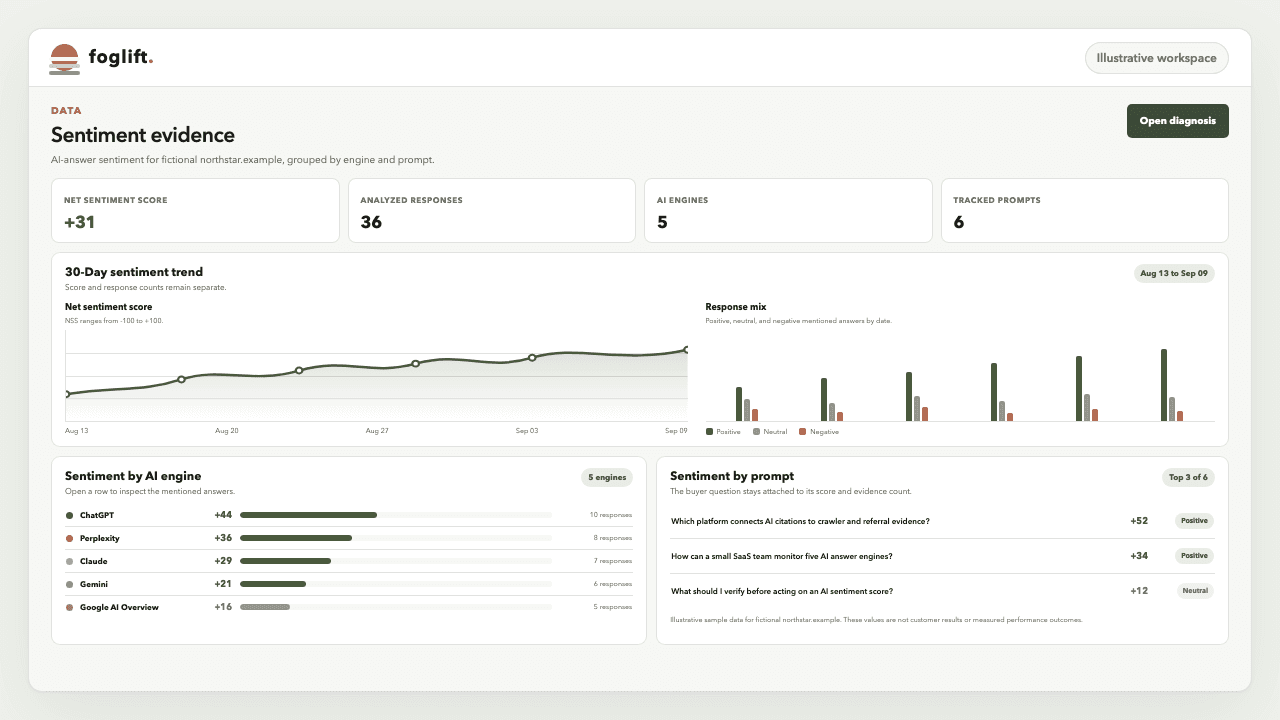
Overall
Net Sentiment Score uses genuine answers that mention the brand. Answers that omit the brand stay in visibility measurement and never enter the sentiment denominator.
By engine
Compare the score, label, positive, neutral, negative, and total mentioned answers for every enabled engine. Open the underlying rows before treating a difference as a pattern.
By prompt
Rank prompts by their measured sentiment and response count. A favorable category question and a caveated comparison question remain separate evidence groups.
By competitor
Tracked competitors keep their own mention counts and available sentiment scores. Missing competitor scores remain unavailable instead of being converted to neutral.
Score methodology
Know exactly which answers moved the number before you brief your team. The score uses only genuine brand mentions, so an omitted brand never gets counted as neutral sentiment.
Use enabled-engine answers in the 30-day window. Keep only rows where the brand was genuinely mentioned, excluding disambiguation guesses that the enrichment layer marked as false matches.
Use the continuous response score when it exists. In a mixed legacy window, unscored positive, neutral, and negative rows contribute +0.5, 0, and -0.5 respectively.
Average the normalized values, multiply by 100, and round. A fully categorical window uses (positive minus negative) divided by mentioned answers, then multiplies by 100.
| Label | Rounded score | What it says |
|---|---|---|
| Negative | -100 to -20 | The measured answer set carries net unfavorable framing. |
| Neutral | Above -20 to below +20 | The measured answer set has balanced or factual framing. |
| Positive | +20 to +100 | The measured answer set carries net favorable framing. |
Trend contract
See whether a new caveat is isolated or spreading across repeated answers. Every trend bucket keeps its mentioned-answer count, so one response never looks as convincing as twenty.
Thirty dated buckets preserve score and positive, neutral, negative, and total mentioned-answer counts.
A day with zero answers is no evidence. Its zero score does not mean neutral sentiment.
For each enabled engine, compare the dominant label in the most recent seven days with the prior seven days.
An alert requires measured answers in both periods and appears only when the label changes.
Open the prompt, engine, competitor, driver, or recommendation type to inspect the answer rows in the same date window.
The score summarizes the rows. The answer text supplies the reviewable evidence.
Theme evidence
Give your team the recurring phrase, its source engine, and the answers behind it. Foglift groups the response evidence and requires repetition before a negative theme can enter the action queue.
01
Review up to 40 recent mentioned answers from the prior 30 days. Theme extraction waits for at least five source rows and uses only the supplied answer evidence.
02
Each theme stores polarity, a sample phrase, source engine, occurrence count, recent and prior counts, trend state, and the dates on which it appeared.
03
A negative theme needs at least two quoted occurrences before Recommendations can create a sentiment action. One isolated phrase does not meet the trigger.
04
The recommendation names the theme and preserves its evidence. Later observations check whether the same theme improved after the team changes a page or source record.
Operating workflow
Keep buyer, category, comparison, and brand-direct questions on a recurring schedule so changes can be compared against the same intent.
Start with the engine or prompt that has enough mentioned answers to review. Read the exact praise, caveat, or warning before choosing a fix.
Use returned citations when available, then determine whether the claim lives on an owned page, review site, comparison, community thread, or another source.
Update the inaccurate or incomplete source with current, checkable facts. Preserve the prior answer and the date of the intervention.
Wait for later completed checks, then compare the score, label, theme, and full answer. Timing can show movement, but it does not prove one edit caused the change.
Plans and cadence
Start with one-brand active-use weekly Perplexity monitoring on Free. Launch adds all five engines, daily cadence, and developer access, while higher plans increase brand capacity and frequency.
| Plan | Monthly | Monitoring coverage | Sentiment workflow |
|---|---|---|---|
| Free | $0 | One brand with active-use weekly Perplexity monitoring | Overall, daily, engine, prompt, competitor, and enrichment views from available mentioned answers |
| Launch | $49/mo | Three brands, five engines, and up to daily monitoring | Free views plus REST API, CLI, MCP, webhooks, and full-site Technical Audits |
| Growth | $129/mo | Ten brands, five engines, and up to twice-daily monitoring | Launch workflow plus Buyer-intent Win Rate, Slack and Discord connections, and Client Portal |
| Enterprise | Custom | Custom brand allowances and up to hourly monitoring | Custom allowances, Microsoft Teams, and full white-label delivery |
Provider evidence
Provider documentation establishes that some search-enabled answers can show citations or supporting links. Source availability varies by engine and response, so Foglift keeps a missing citation unavailable and never invents a URL to explain a sentiment score.
Explains that web-search answers may include citations and that users should open the cited source to verify the result.
Documents direct citations and source links in web-search responses when the feature is enabled.
Explains that AI Overviews and AI Mode may show supporting links and may use different techniques and source sets.
Provider sources reviewed September 8, 2026.
Questions
AI brand sentiment analysis measures how answer engines frame a brand when they mention it. Foglift preserves the prompt, engine, answer text, observation date, sentiment, competitors, and returned citations so a score can be traced back to the language that produced it.
Foglift calculates Net Sentiment Score only from genuine answers that mention the brand. Continuous response scores are averaged on a -1 to +1 scale and converted to a rounded -100 to +100 score. Legacy unscored rows in a mixed window use +0.5 for positive, 0 for neutral, and -0.5 for negative. A fully categorical window uses positive answers minus negative answers, divided by mentioned answers, then multiplied by 100.
No. Brand absence belongs to visibility measurement. Foglift excludes unmentioned answers from the sentiment denominator and measures visibility separately, so a missing brand cannot make sentiment look more neutral or more positive.
Free workspaces use active-use weekly Perplexity monitoring for one brand. Launch and higher plans can measure ChatGPT, Claude, Perplexity, Gemini, and Google AI Overview. Launch supports up to daily monitoring, Growth up to twice daily, and Enterprise up to hourly monitoring.
A Net Sentiment Score of +20 or higher is positive, -20 or lower is negative, and a score between those thresholds is neutral. The label summarizes a measured answer set. The underlying answer text remains the evidence for the praise, factual mention, caveat, or warning.
Foglift groups supported themes from recent answers and keeps the source engine, sample quote, occurrence count, and recent trend. A negative theme can become a recommendation only after at least two quoted occurrences support it. Later answer evidence is used to verify whether the same theme improved.
Yes. Developer access starts on Launch at $49 per month. The sentiment API accepts a one-day to 90-day window and returns the overall score, daily trend, engine and prompt groups, alerts, competitor sentiment, and enrichment evidence. The CLI and MCP expose the same account-scoped workflow for supported developer plans.
No. A returned citation is evidence attached to the observed answer, but it does not expose a provider's hidden weighting or prove that one page caused the wording. Citation availability also varies by engine. Foglift keeps missing citations unavailable and preserves the full answer for review.
Start with evidence
Open the answer evidence in Sentiment, or compare plans for five-engine cadence and developer access.
Developers can use the REST API, CLI, or Connect Assistant from Launch.