Landscape
Visibility and sentiment together
Plot your brand and each tracked competitor from the same 30-day industry-prompt answers. Visibility measures how often the brand appears; sentiment measures how positively those appearances are framed.
Competitor intelligence
See when ChatGPT, Perplexity, Claude, Gemini, and Google AI Overview recommend a competitor. Open the answer, compare position and sentiment, and trace the outside sources shaping the result. Foglift keeps your brand and tracked or newly discovered competitors on the same prompt-level evidence.
Four views, one answer set
Each view moves from summary to answer. The landscape shows market position, the matrix separates engines, head-to-head exposes the deciding rows, and discovery catches brands you did not configure.
Landscape
Plot your brand and each tracked competitor from the same 30-day industry-prompt answers. Visibility measures how often the brand appears; sentiment measures how positively those appearances are framed.
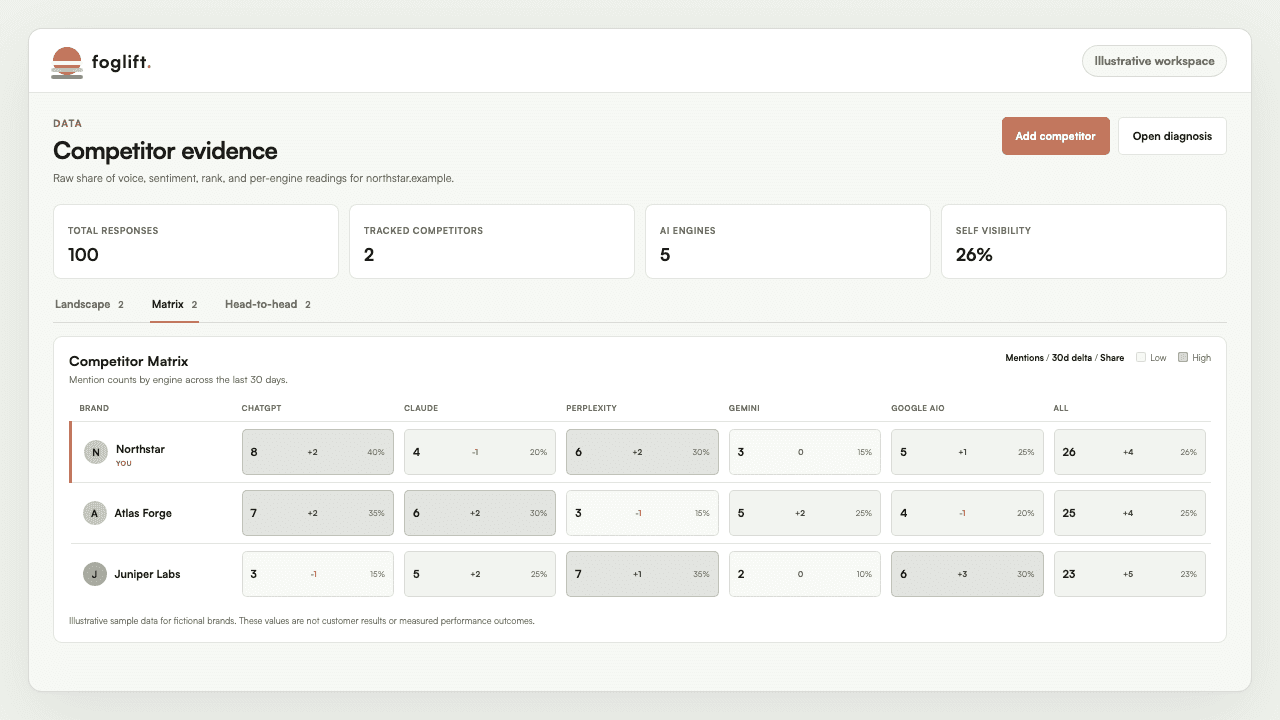
Matrix
Compare mention counts across ChatGPT, Claude, Perplexity, Gemini, and Google AI Overview. Each cell keeps the response denominator and prior-window count instead of blending unlike engines.
Head-to-head
Filter winning, losing, tied, or all informative answers for one competitor. Open a row to inspect the prompt, engine, response, positions, sentiment, returned citations, and observation date.
Discovery
Review up to five untracked competitor suggestions ranked by observed mentions. Add a valid domain to the tracked set or dismiss a suggestion so it does not keep returning.
Comparable measurement
The 30-day landscape uses active industry prompts that do not name your brand or a competitor. That prevents branded and comparison questions from manufacturing visibility simply because a name appears in the prompt.
Head-to-head rules
Foglift classifies each answer with the same ordered rule set. The result describes that answer for that prompt and date. It is evidence of answer selection, not a claim about overall product quality.
| Evidence checked | Rule | Outcome |
|---|---|---|
| Presence | Only your brand appears | You win |
| Presence | Only the competitor appears | They win |
| Answer position | Both appear with known, different positions | The earlier position wins |
| Sentiment | Position does not decide it and the sentiment gap is greater than 0.3 | The more positive brand wins |
| Tie or exclusion | The gap stays within 0.3, or neither brand appears | Tied, or omitted if neither appears |
Untracked competitors
A configured list can miss the brand an engine starts recommending next week. Open extraction reads the observed answers first, then applies conservative identity and noise filters before suggesting a domain.
01
Read brand-shaped mentions from answers tied to active prompts during the last 30 days.
02
Collapse aliases so a company name and its domain resolve to one candidate when the evidence supports that match.
03
Remove your brand, tracked and dismissed competitors, generic phrases, social platforms, and other low-signal candidates.
04
Return up to five candidates by observed mention count, with a stable alphabetical tie break.
Source-gap analysis
The Launch+ MCP tool get_source_gap reads one to 90 days of citation evidence. It returns up to 20 domains, with a 30-day window and eight results by default.
Citation data is provider-dependent. Foglift keeps unavailable source data unavailable instead of treating it as zero or inferring a URL.
Operating loop
Track industry prompts that a buyer could ask without naming you or a competitor. Brand and comparison prompts are excluded from the landscape because they mechanically inflate mention rates.
Start with the per-engine matrix. A single blended number can hide that one engine selects a different competitor set from the others.
Use head-to-head filters to separate absence, lower position, and weaker framing. Each condition points to a different response.
Run the source-gap tool for the same brand. Improve your page when a better vendor page wins; seek independent evaluation when a roundup, review, community thread, or publication supplies the authority.
Keep the prompts, engines, and evidence window stable after the change. New answer-level evidence shows whether the matchup actually moved.
Plans and cadence
Free uses the same one-brand, active-use weekly Perplexity evidence as AI Visibility monitoring. Launch adds all five engines, daily cadence, full-site Technical Audits, and developer access. Higher plans increase brand capacity and cadence while preserving the same evidence contract.
| Plan | Monthly | Monitoring coverage | Competitor workflow |
|---|---|---|---|
| Free | $0 | One brand with active-use weekly Perplexity monitoring and unlimited single-page Technical Audits | Competitor views use the same active-use weekly Perplexity evidence |
| Launch | $49/mo | Three brands, five-engine monitoring at up to daily cadence, and full-site Technical Audits | Competitor dashboard plus REST API, CLI, MCP, and get_source_gap |
| Growth | $129/mo | Ten brands and five-engine monitoring at up to twice-daily cadence | Launch access plus Buyer-intent Win Rate |
| Enterprise | Custom | Custom brand allowances and five-engine monitoring at up to hourly cadence | Growth access plus full white-label delivery |
Questions
AI competitor tracking compares how often your brand and named competitors appear in answers to the same monitored prompts. A useful system preserves the engine, answer, date, mention status, answer position, sentiment, and returned citation URLs so every comparison can be traced to evidence.
Foglift checks presence first. If only one brand appears, that brand wins the answer. If both appear, the earlier answer position wins. When position does not decide it, a sentiment difference greater than 0.3 decides the result; otherwise the answer is tied. Answers that mention neither brand are excluded.
Yes. Foglift extracts brand-shaped mentions from the last 30 days of active-prompt answers, collapses aliases such as a brand name and its domain, removes your own brand plus tracked or dismissed competitors, filters common false positives, and suggests up to five untracked brands ranked by observed mentions.
A source gap is a third-party domain cited in answers where your brand is absent and not cited in answers where your brand appears during the same evidence window. Foglift ranks these domains by citation count, shows the competitors that appear beside them, and adds an authority-based attainability label when authority data is available.
No. Citation availability depends on the provider. Foglift stores returned source URLs without inventing missing citations. The current Gemini monitoring lane does not expose citation tracking, while Google AI Overview remains independently grounded.
Foglift includes competitor views on Free using the same one-brand, active-use weekly Perplexity evidence as AI Visibility monitoring. Launch costs $49 per month and adds all five engines, daily cadence, full-site Technical Audits, plus REST API, CLI, and MCP access. Growth costs $129 per month and raises the cadence ceiling to twice daily while adding Buyer-intent Win Rate. Enterprise pricing is custom.
Compare tracked competitors in Foglift, then use the source layer to choose the next page, proof point, or independent evaluation.
Need the workflow inside an assistant? Read the Connect Assistant specification or the MCP integration guide.