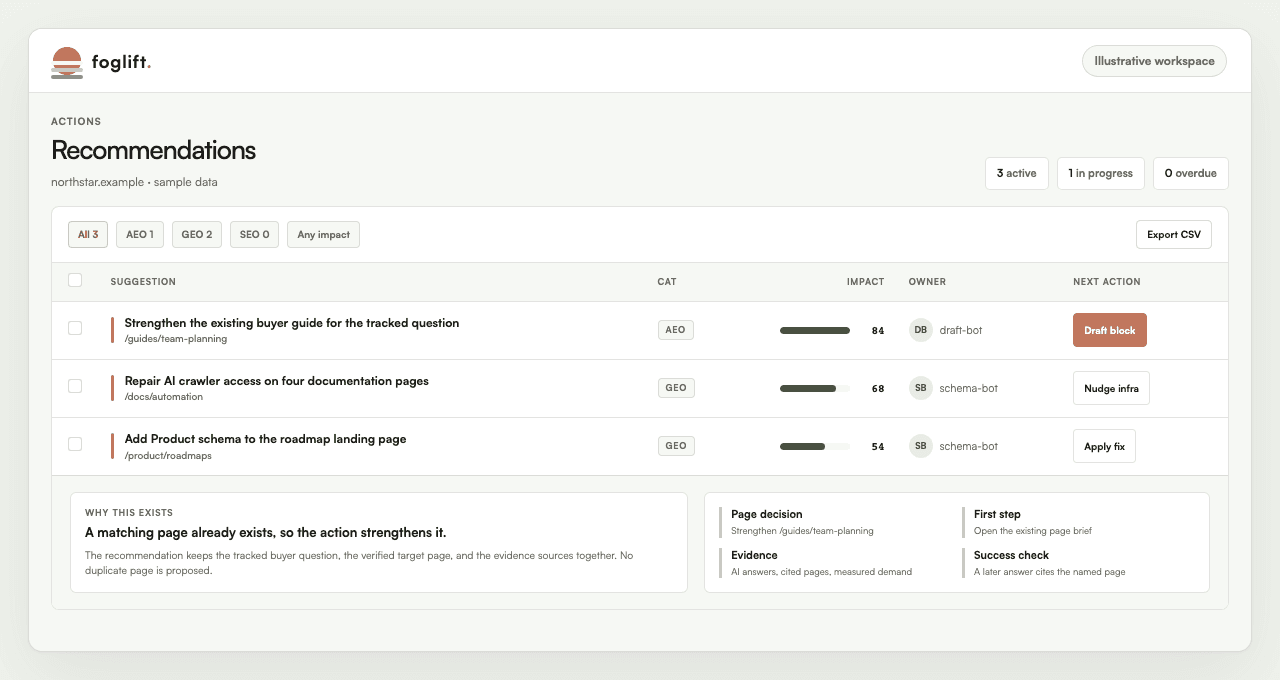
A matching page exists
Strengthen
The plan names one verified URL, opens with that page as the first step, and carries the measured prompt plus related questions into the update.
Recommendations
Foglift turns AI Visibility Checks, search demand, cited pages, Technical Audits, crawler evidence, and sentiment into one ranked action list. Open the next move, see why it rose to the top, and know which later result will prove the work paid off.
Evidence before advice
Stop reconciling separate dashboards before every planning meeting. Each recommendation can combine four evidence groups while preserving the observation date and source behind every fact.
| Evidence group | What it observes | What it changes |
|---|---|---|
| AI answer evidence | Brand mentions, answer position, competitors, citations, engines, and prompt history | Visibility gaps, competitor displacement, citation targets, and later mention-rate checks |
| Measured demand | Search Console impressions, prompt opportunities, and related-question fan-outs | Demand input, buyer-intent context, and the questions carried into a page plan |
| Technical Audit | Page inventory, technical findings, sitemap coverage, internal links, and crawler policy | Feasibility, affected-page footprint, page selection, and audit-based verification |
| Audience signals | Sentiment themes, AI referral activity, and connected measurement status | Sentiment actions, source-connection actions, and evidence limits |
Deterministic ranking
Give your team a stable order it can inspect and repeat. The ranking and plan-selection contract uses no runtime language-model call. Six explicit inputs determine the score, and a logarithmic display scale keeps one large number from hiding every other useful action.
01
How closely the finding maps to a buyer decision or an executable access problem.
02
The measured gap between the desired outcome and the brand's present mention rate.
03
Observed impressions or prompt volume when available, with an explicit proxy label when it is not.
04
How realistic the cited-source opportunity is, based on the available authority evidence.
05
Whether the system has a direct connection, an audit-derived fix, or a verified page inventory to act on.
06
How many pages share the finding, scaled so one large template problem does not overwhelm every other action.
One page decision
Keep a measured gap from turning into another overlapping article. Foglift checks the verified sitemap and Technical Audit inventory, then routes the work to an existing page whenever the match is strong enough.
A matching page exists
The plan names one verified URL, opens with that page as the first step, and carries the measured prompt plus related questions into the update.
No page clears the match
The plan recommends one new page for the exact measured question. It preserves related fan-out questions as scope instead of producing a generic topic idea.
What can become an action
Find prompts with measured demand, low mention rate, or competitor displacement. Attach the prompt standing, cited winning pages, and related questions.
Surface high-centrality uncited pages, important thin or orphan pages, repeated technical defects, and site-architecture gaps with the affected URLs attached.
Separate restricted crawler access from missing measurement connections. A direct connection can outrank speculative content work when it improves several current actions.
Create an action only when a negative theme has repeated observed occurrences, then preserve the supporting quotes and engines as evidence.
Visible decision record
Hand work to a writer, marketer, or engineer without losing the reasoning behind it. The detail view keeps the diagnosis, page decision, first step, effort, evidence, and success check together.
One direct action with a human-readable title and current status.
Demand, current standing, and the stakes tied to the observed evidence.
The buyer or technical job the action is meant to address.
Source-labeled blocks with observation dates, facts, and provenance.
Effort, scope, first step, and the measurement that can mark the work done.
Run counts, engines, parse freshness, and the boundary that engines make the final selection.
Proof after the work
Close an action with later evidence instead of a checked box. Only observations collected after an action was generated can verify it, using the success rule attached to that recommendation.
Example verification contract
Plans and evidence breadth
Recommendations are available on every plan. Higher monitoring cadence, more engines and brands, and connected surfaces add evidence to the same deterministic action framework.
| Plan | Monthly price | Evidence available to recommendations |
|---|---|---|
| Free | $0 | Active-use weekly Perplexity monitoring, one brand, and unlimited single-page Technical Audits |
| Launch | $49/mo | Daily monitoring across five engines, three brands, full-site Technical Audits, REST API, CLI, MCP, and webhooks |
| Growth | $129/mo | Twice-daily monitoring, ten brands, and Buyer-intent Win Rate |
| Enterprise | Custom | Hourly monitoring, custom allowances, and full white-label delivery |
Questions
AI search recommendations turn observed visibility, demand, citation, page, crawler, and sentiment evidence into a ranked action list. Each action states what to do, why it matters, which evidence supports it, and how later measurements will verify progress.
Each recommendation receives a deterministic score from six inputs: intent, current loss, demand, attainability, feasibility, and affected-page footprint. The product then breaks ties by demand, related-question count, competitor pressure, page footprint, and a stable identifier.
No. The current ranking and plan-selection contract is deterministic and uses no runtime language-model call. The same evidence produces the same ranked plan, and the reason graph preserves the facts and rules behind the decision.
The planner checks the verified sitemap and Technical Audit inventory for a page that already matches the measured topic. It selects one existing page to strengthen when the match clears the contract threshold. Otherwise it recommends a new page and carries related buyer questions into the plan.
Verification uses evidence collected after the recommendation was generated. Depending on the action, the product checks later mention rate, a newly observed citation, a cleared Technical Audit finding, allowed crawler access, improved sentiment, or a connected data source.
Recommendations are available on every plan. Its evidence breadth follows the plan and connected sources: Free includes active-use weekly Perplexity monitoring and unlimited single-page Technical Audits, while Launch starts at $49 per month and adds daily monitoring across five engines, full-site Technical Audits, plus API, CLI, and MCP access.
Open Recommendations in Foglift, or review the monitoring and developer access included with each plan.
Engineers can read the MCP integration and developer API documentation.